Showing posts with label Colorectal. Show all posts
Showing posts with label Colorectal. Show all posts
Wednesday, November 17, 2010

Wednesday, July 28, 2010
Radiation Proctitis
Can result from external beam radiation or brachytherapy for cervical or prostate cancer.
Radiation oncologists can try and reduce incidence by using differential dosing during radiation or by using spacer techniques to increase distance between treated organ and rectum.
Complications of radiation proctitis include:
- bleeding
- tenesmus
- stricturing
- incontinence
- fistulas
- diarrhea
Mild radiation proctitis is usually self-limiting and decreases over time
proctitis can be acute or chronic and can present late even in the absence of immediate proctitis
Treatment options include:
- nothing
- enemas (cortisone, 5-ASA); evidence for these treatments is sparse and potentially can even cause more harm
- medium chain fatty acids
- Formalin/methanol topical application
- YAG laser
- thermal cautery
- if severe stricturing or fistulization then procetectomy or diverting colostomy maybe required
Radiation oncologists can try and reduce incidence by using differential dosing during radiation or by using spacer techniques to increase distance between treated organ and rectum.
Complications of radiation proctitis include:
- bleeding
- tenesmus
- stricturing
- incontinence
- fistulas
- diarrhea
Mild radiation proctitis is usually self-limiting and decreases over time
proctitis can be acute or chronic and can present late even in the absence of immediate proctitis
Treatment options include:
- nothing
- enemas (cortisone, 5-ASA); evidence for these treatments is sparse and potentially can even cause more harm
- medium chain fatty acids
- Formalin/methanol topical application
- YAG laser
- thermal cautery
- if severe stricturing or fistulization then procetectomy or diverting colostomy maybe required
Thursday, April 15, 2010
Laparoscopic Surgery for Crohn's disease
Possible challenges to laparoscopic surgery in Crohn's disease:
- Inflammatory mass
- abscess
- anatomical orientation: previous operation, fistualous connections
- adhesions
- difficult dissesction
- bleeding high conversion rate
Patient preparation:
- Drain abscess: keep drain until time of surgery
- Optimize nutrition with elemental diet (preferable over TPN)
SB resections:
- if single site can consider intracorporeal anastamosis
- if multiple sites will be faster to exteriorize each site
conversion to open procedure is not associated with an adverse outcome.
Laparoscopic resection only accounts for <10% of crohn's resection
-no impact on Long term QOL or function.
- Inflammatory mass
- abscess
- anatomical orientation: previous operation, fistualous connections
- adhesions
- difficult dissesction
- bleeding high conversion rate
Patient preparation:
- Drain abscess: keep drain until time of surgery
- Optimize nutrition with elemental diet (preferable over TPN)
SB resections:
- if single site can consider intracorporeal anastamosis
- if multiple sites will be faster to exteriorize each site
conversion to open procedure is not associated with an adverse outcome.
Laparoscopic resection only accounts for <10% of crohn's resection
-no impact on Long term QOL or function.
Surgery for Colonic Crohn's Disease
Segmental vs total colectomy:
- distribution of diseae: previous or concurrent SB disease
- status of rectum
- age of patient
- rate of recurrence
- don't leave your anastaomosis next to the duodenum; if recurrence forms develops a duodenal fistula
- Transeverse colon disease: segmental transverse colectomy results in huge mesenteric defect; better to do subtotal and anastamosis to sigmoid colon
- multisegmental pancolonic crohn's: consider IRA if pts sphincter fxn will tolerate
- distribution of diseae: previous or concurrent SB disease
- status of rectum
- age of patient
- rate of recurrence
- don't leave your anastaomosis next to the duodenum; if recurrence forms develops a duodenal fistula
- Transeverse colon disease: segmental transverse colectomy results in huge mesenteric defect; better to do subtotal and anastamosis to sigmoid colon
- multisegmental pancolonic crohn's: consider IRA if pts sphincter fxn will tolerate
Immunomodulators and their impact on Surgery in IBD
Do immunomodulators increase risks of surgery?
- no good prospective studies on this topic
Appau etl al, J Gastrointest Surg 2008: Effects of infliximab on ileocolic resection
- use of steroids in non-infliximab group higher
- rate of sepsis and readmission higher in IFX group
- trend toward leak and reoperation in IFX group
Columbel et al, Mayo Clinic
- no difference in septic complications after use of IFX, AZA/6-MP/MTX, steroids
Kunitake, J Gastro surg 2008
- no significant difference in complication rate.
Therefore, conflicting data on whether they cause complications
- all retrospective and had methodological flaws
- One speaker suggested that pts of on combinations of IFX and steroids are at risk of anastamotic leak.
When should you stop immunomodulators?
- if attenuation to IFX, consider trying a 2nd biologic
- for fibrostenotic disease, will need surgery
- worsens obstruction as quick healing results in worsening of fibrostenotic disease
- stop if develop abscess
- failure of 2nd biologic
- always worry about possibility of malignancy
- stop 1 month prior to surgery: OK to continue AZA/6-MP/MTX until date of surgery
- no good prospective studies on this topic
Appau etl al, J Gastrointest Surg 2008: Effects of infliximab on ileocolic resection
- use of steroids in non-infliximab group higher
- rate of sepsis and readmission higher in IFX group
- trend toward leak and reoperation in IFX group
Columbel et al, Mayo Clinic
- no difference in septic complications after use of IFX, AZA/6-MP/MTX, steroids
Kunitake, J Gastro surg 2008
- no significant difference in complication rate.
Therefore, conflicting data on whether they cause complications
- all retrospective and had methodological flaws
- One speaker suggested that pts of on combinations of IFX and steroids are at risk of anastamotic leak.
When should you stop immunomodulators?
- if attenuation to IFX, consider trying a 2nd biologic
- for fibrostenotic disease, will need surgery
- worsens obstruction as quick healing results in worsening of fibrostenotic disease
- stop if develop abscess
- failure of 2nd biologic
- always worry about possibility of malignancy
- stop 1 month prior to surgery: OK to continue AZA/6-MP/MTX until date of surgery
Laparoscopic IPAA
Options include:
- open laparotomy
- Lap assisted: mobilize colon laparoscopically and use low phannenstiel incision for extraction and creation of pouch
- Hand-assisted procedure
- completely laparoscopic - extraction site through ileostomy site (need normal BMI)
- single incision:
5 step Lap Total Colectomy - IPAA:
- mobilize left colon
- mobilize right colon - preserve ileocolic vessels for pouch
- rectal dissection: - uterus suspended with suture and sponge stick in vagina
- exteriorization of colon through ileostomy site: pt must be thin, bowel must be prepped
- anastamosis
Dr. Marks steps:
- takes infra colic
- takes ileo-colic vessels and divides ileum early so by end of case has sense of blood supply
- mobilize right colon
- middle colic division (branches ~3.5cm from take-off of SMA)
- divide omentum/supracolic dissection
- Closckwise rotation of cecum upto LUQ - allows you to follow the mesentery down to rectum
- pelvic dissection
- uses 30mm stapler coming vertically from supra pubic port site
Gaining length on SMA.
- fenestrate SB mesentery
- open laparotomy
- Lap assisted: mobilize colon laparoscopically and use low phannenstiel incision for extraction and creation of pouch
- Hand-assisted procedure
- completely laparoscopic - extraction site through ileostomy site (need normal BMI)
- single incision:
5 step Lap Total Colectomy - IPAA:
- mobilize left colon
- mobilize right colon - preserve ileocolic vessels for pouch
- rectal dissection: - uterus suspended with suture and sponge stick in vagina
- exteriorization of colon through ileostomy site: pt must be thin, bowel must be prepped
- anastamosis
Dr. Marks steps:
- takes infra colic
- takes ileo-colic vessels and divides ileum early so by end of case has sense of blood supply
- mobilize right colon
- middle colic division (branches ~3.5cm from take-off of SMA)
- divide omentum/supracolic dissection
- Closckwise rotation of cecum upto LUQ - allows you to follow the mesentery down to rectum
- pelvic dissection
- uses 30mm stapler coming vertically from supra pubic port site
Gaining length on SMA.
- fenestrate SB mesentery
Medical Management of IBD
UC Remission:
- Aminosalicylates:
- can give oral or topically or combined
- Pentasa has earlier release in stomach and SB vs. Asacol and sulfasalazime which are activated more in the colon
- ensure that patient has had an adequate dose prior to declaring the patient has failed on this treatment
- Steroids:
- Immunomodulators:
- cyclosporine: small percentage of the population who have fulminant disease as a bridge to early surgery
- azathioprine/6-MP: steroid refractory patients
CD remission:
- 5-ASA
- Antibiotics
- Steroids: Budesonide - 9 mg: long-term therapy has fewer cushingoid SE but still at risk of osteoporosis
infliximab:
- SE: lymphoma, TB, death
- Present, Et al NEJM 1999; infliximab for fistulizing crohn's disease
Methotrexate:
- complication profile is significant and not generally used often
Indications for surgery:
- failure of medical management: make sure pt just doesn't need better monitoring of taking meds
- obstruction
- bleeding
- perforation
- CD: not operating for cure; managing complications and QOL
Risk of Malignancy:
- UC after 10 years needs 4 quadrant biopsy every 10 cm
- DALM: unless adenoma like then likely requires resection.
- Aminosalicylates:
- can give oral or topically or combined
- Pentasa has earlier release in stomach and SB vs. Asacol and sulfasalazime which are activated more in the colon
- ensure that patient has had an adequate dose prior to declaring the patient has failed on this treatment
- Steroids:
- Immunomodulators:
- cyclosporine: small percentage of the population who have fulminant disease as a bridge to early surgery
- azathioprine/6-MP: steroid refractory patients
CD remission:
- 5-ASA
- Antibiotics
- Steroids: Budesonide - 9 mg: long-term therapy has fewer cushingoid SE but still at risk of osteoporosis
infliximab:
- SE: lymphoma, TB, death
- Present, Et al NEJM 1999; infliximab for fistulizing crohn's disease
Methotrexate:
- complication profile is significant and not generally used often
Indications for surgery:
- failure of medical management: make sure pt just doesn't need better monitoring of taking meds
- obstruction
- bleeding
- perforation
- CD: not operating for cure; managing complications and QOL
Risk of Malignancy:
- UC after 10 years needs 4 quadrant biopsy every 10 cm
- DALM: unless adenoma like then likely requires resection.
Laparoscopic Resection for IBD
General Principles:
- Ensure that you review pathology to differentiate CD from UC
Chronic Crohn's Colitis:
- NEVER do a segmental resection
- Controversy regarding reconstruction, IRA can be considered in select patients with rectal sparing. Pt must be informed that inevitable re-resection of rectum is likely.
- Ensure that you review pathology to differentiate CD from UC
- Perianal disease is a red flag for CD.
- however, may be coincidental, biopsies of local fistula may not differentiate
- increased perioperative morbidity in pts on Remicaide
- Safest approach would be to perform total colectomy to get better pathology and return to fight another day.
Chronic Crohn's Colitis:
- NEVER do a segmental resection
- Controversy regarding reconstruction, IRA can be considered in select patients with rectal sparing. Pt must be informed that inevitable re-resection of rectum is likely.
Friday, February 19, 2010
Colonic Volvulus
Recurrence rate after endoscopic detorsion ranges from 30-90%. Morbidity and mortality increases with each successiev detorsion.
- mortality of elective resection is low (1-5%), recurrence rate after resection low (~5%).
- If operative risk is too high - consider percutaneous endoscopic transcolonic tube placement
- recurrence rate of cecal volvulus is also high (20-40%): cecopexy or resection with primary anastamosis are eqully safe with similar recurrence rates (5-15%)
- mortality of elective resection is low (1-5%), recurrence rate after resection low (~5%).
- If operative risk is too high - consider percutaneous endoscopic transcolonic tube placement
- recurrence rate of cecal volvulus is also high (20-40%): cecopexy or resection with primary anastamosis are eqully safe with similar recurrence rates (5-15%)
Saturday, February 6, 2010
Extracolonic manifestations of Ulcerative Colitis
Pyoderma gangrenosum
Erythema nodosum
Ankylosing spondylitis
Sclerosing cholangitis
Erythema nodosum
Ankylosing spondylitis
Sclerosing cholangitis
Wednesday, November 18, 2009
Colon Cancer Staging
Stage 1: T1N0 or T2N0
Stage 2: T3N0 or T4N0
Stage 3: Any T, N1 or 2
Stage 4: Any T, Any N, M1
T1: invades into submucosa
T2: invades into muscularis propria
T3: invades through muscularis propria into subserosa or non-peritonealized pericolonic tissue
T4: invades through serosa into adjacent organs
N0: 0 LN mets (min 12 LN sampled)
N1: 1-3 LN
N2: >=4 LN
Stage 2: T3N0 or T4N0
Stage 3: Any T, N1 or 2
Stage 4: Any T, Any N, M1
T1: invades into submucosa
T2: invades into muscularis propria
T3: invades through muscularis propria into subserosa or non-peritonealized pericolonic tissue
T4: invades through serosa into adjacent organs
N0: 0 LN mets (min 12 LN sampled)
N1: 1-3 LN
N2: >=4 LN
Desmoid Tumors
Difficult to treat desmoplastic reaction usually in mesentery.
- Associated with FAP
- Severity of desmoid reaction is inversely proportional to the number of polyps.
- therefore, some argue that pts with attenuated FAP with fewer polyps should have surgery delayed as long as possible to prolong the risk of developing post-op desmoid tumors
Treatment:
- treatment of desmoid tumors is limited.
- NO Surgery! Desmoplastic reaction only gets worse with each surgery
- only effective therapy is adriamycin based chemotherapy
- Associated with FAP
- Severity of desmoid reaction is inversely proportional to the number of polyps.
- therefore, some argue that pts with attenuated FAP with fewer polyps should have surgery delayed as long as possible to prolong the risk of developing post-op desmoid tumors
Treatment:
- treatment of desmoid tumors is limited.
- NO Surgery! Desmoplastic reaction only gets worse with each surgery
- only effective therapy is adriamycin based chemotherapy
Tuesday, November 17, 2009
Diagnostic Criteria for Lynch Syndrome
Amsterdam Criteria (3-2-1):
Amsterdam criteria was developed for research and therefore very specific criteria.
- 3 relatives with colon ca
- 2 generations
- 1 family member <50 yo
Modified Amsterdam and Bethesda criteria were subsequently developed to be further encompassing.
Modified Amsterdam Criteria:
- same as Amsterdam criteria but cancers can also include: colon, small bowel, ureter, renal pelvis and endometrial ca.
Bethesda Criteria:
- Amsterdam criteria or
- 2 cases of HNPCC cancers in 1 pt, including synch or metach CRC
- Colon CA and 1st deg relative with CA/adenoma (CA <45, adenoma <40)
- Colon or endometrial CA <45
- R sided colon CA with histo undiff, solid, cribiform, signet-cell <45
- Adenoma <40
Amsterdam criteria was developed for research and therefore very specific criteria.
- 3 relatives with colon ca
- 2 generations
- 1 family member <50 yo
Modified Amsterdam and Bethesda criteria were subsequently developed to be further encompassing.
Modified Amsterdam Criteria:
- same as Amsterdam criteria but cancers can also include: colon, small bowel, ureter, renal pelvis and endometrial ca.
Bethesda Criteria:
- Amsterdam criteria or
- 2 cases of HNPCC cancers in 1 pt, including synch or metach CRC
- Colon CA and 1st deg relative with CA/adenoma (CA <45, adenoma <40)
- Colon or endometrial CA <45
- R sided colon CA with histo undiff, solid, cribiform, signet-cell <45
- Adenoma <40
Lower GI Bleeding
Investigations:
- Success of imaging directed at identifying the source of bleeding will largely depend on the ongoing rate of bleeding.
- Angiogram: 0.5 cc/min
- RBC scan: 0.1 cc/min
- Success of imaging directed at identifying the source of bleeding will largely depend on the ongoing rate of bleeding.
- Angiogram: 0.5 cc/min
- RBC scan: 0.1 cc/min
Risk of Cancer in IBD
Risk increases significatntly 8 years after pancolitis:
Therefore, recommendation is to begin colonscopic screening 8 years after the onset of pancolitis.
- In patients with left-sided colitis only, screening can begin 12-15 years after the onset of disease.
Therefore, recommendation is to begin colonscopic screening 8 years after the onset of pancolitis.
- In patients with left-sided colitis only, screening can begin 12-15 years after the onset of disease.
Layers of Bowel Wall
- Lumen (interior surface of colon "tube")
- Mucosa
- Lamina propria or basement membrane—dividing line between in situ and invasive lesions
- Muscularis mucosae
- Submucosa—lymphatics; potential for metastases increases
- Muscularis propria
- Circular layer
- Longitudinal layer—in three bands called taenia coli
- Subserosa—sometimes called pericolic fat or subserosal fat
- Serosa—present on ascending, transverse, sigmoid only (also called the visceral peritoneum)
- Retroperitoneal fat (also called pericolic fat)
- Mesenteric fat (also called pericolic fat)
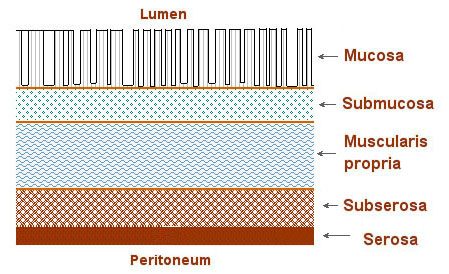
http://training.seer.cancer.gov/images/colorectal/layers.jpg
Haggitt Levels - Colonic Polyps
Describe invasion of invasive carcinoma in pedunculated colonic polyps. The Kudo classification is used to describe invasion in sessile polyps.
Level 0 - CIS (carcinoma confined to mucosal layer)
Invasion through Lamina propria:
Level 1 - invasion into submucosa limited to head of polyp
Level 2 - invasion into submucosa extending to neck of polyp
Level 3 - invasion into submucosa extending to stalk of polyp
Level 4 - invasion beyond the stalk but above the muscularis propria
Indications for Surgical Management of Polyps after Polypectomy:
- Positive margins
- Piecemeal resection
- Lymphovascular invasion
- Poorly differentiated
- Haggit level 4
- Unable to resect endoscopically
Level 0 - CIS (carcinoma confined to mucosal layer)
Invasion through Lamina propria:
Level 1 - invasion into submucosa limited to head of polyp
Level 2 - invasion into submucosa extending to neck of polyp
Level 3 - invasion into submucosa extending to stalk of polyp
Level 4 - invasion beyond the stalk but above the muscularis propria
Indications for Surgical Management of Polyps after Polypectomy:
- Positive margins
- Piecemeal resection
- Lymphovascular invasion
- Poorly differentiated
- Haggit level 4
- Unable to resect endoscopically
Monday, November 16, 2009
Diverticulitis
Diagnosis:
- CT is the primary modality by which diverticulitis is diagnosed. Resoltion of LLQ pain after a course of abx does not constitute evidence for an episode of diverticulitis.
- Pts should eventually undergo colonoscopy to rule out malignant processes, most wait 6-8 weeks to prevent blowing out a microperforation.
- 70% of cases of uncomplicated diverticulitis will resolve with medical therapy alone.
- CT is the primary modality by which diverticulitis is diagnosed. Resoltion of LLQ pain after a course of abx does not constitute evidence for an episode of diverticulitis.
- Pts should eventually undergo colonoscopy to rule out malignant processes, most wait 6-8 weeks to prevent blowing out a microperforation.
- 70% of cases of uncomplicated diverticulitis will resolve with medical therapy alone.
Hinchey Classification - Diverticulitis
When originally described based on laparotomy findings. Now it is applied to CT findings.
0: Diverticulosis, no evidence of inflammation
1: Pericolonic or mesenteric abscess
2: Contained pelvic abscess
3: Free purulent perforation
4: Free feculent perforation
Sunday, November 15, 2009
Diverticulitis - Indications for Surgery
Strong Evidence for Surgery:
- Diffuse peritonitis
- Free perforation
- Fistula
- Stricture
- Obstruction
- Immunocompromised patient
- >= 4 uncomplicated episodes
Conflicting Evidence for Surgery:
- After abscess drainage
- Uncomplicated, 2 or 3 episodes
Surgery No Longer Supports Surgery:
- Uncomplicated 1st episode
- Age <50
Broderick-Villa G, 2005: Large retrospective review examining pts with recurrent diverticulitis. After conservative treatment, few (13%) recurred and most of these recurrences were managed conservatively again.
- Diffuse peritonitis
- Free perforation
- Fistula
- Stricture
- Obstruction
- Immunocompromised patient
- >= 4 uncomplicated episodes
Conflicting Evidence for Surgery:
- After abscess drainage
- Uncomplicated, 2 or 3 episodes
Surgery No Longer Supports Surgery:
- Uncomplicated 1st episode
- Age <50
Broderick-Villa G, 2005: Large retrospective review examining pts with recurrent diverticulitis. After conservative treatment, few (13%) recurred and most of these recurrences were managed conservatively again.
Subscribe to:
Posts (Atom)